

Accuracy plays an important role in science, mathematics, and everyday calculations. Whether students are working on laboratory experiments or professionals are analyzing data, understanding how close a measured value is to the true value matters a great deal. One of the most common ways to measure this difference is through percent error. This concept helps people evaluate how accurate a measurement or calculation is compared to an accepted or correct value.
Percent error is widely used in educational settings, especially in science labs and mathematics classes. It allows students and researchers to check the reliability of their work. By expressing the difference between two values as a percentage, it becomes easier to compare results and understand how significant the difference is. Learning about percent error helps individuals improve their calculations and develop better analytical skills.
What Is Percent Error?
Percent error is a mathematical measurement that shows the difference between an experimental value and the accepted value. The experimental value is the result obtained from a measurement or experiment, while the accepted value is the known or correct value based on reliable sources or standards.
The main purpose of percent error is to determine how accurate a measurement is. A smaller percentage means the measurement is very close to the correct value, while a larger percentage indicates a greater difference.
In simple terms, percent error answers an important question: how far off is the measured result from the true value?
The Percent Error Formula
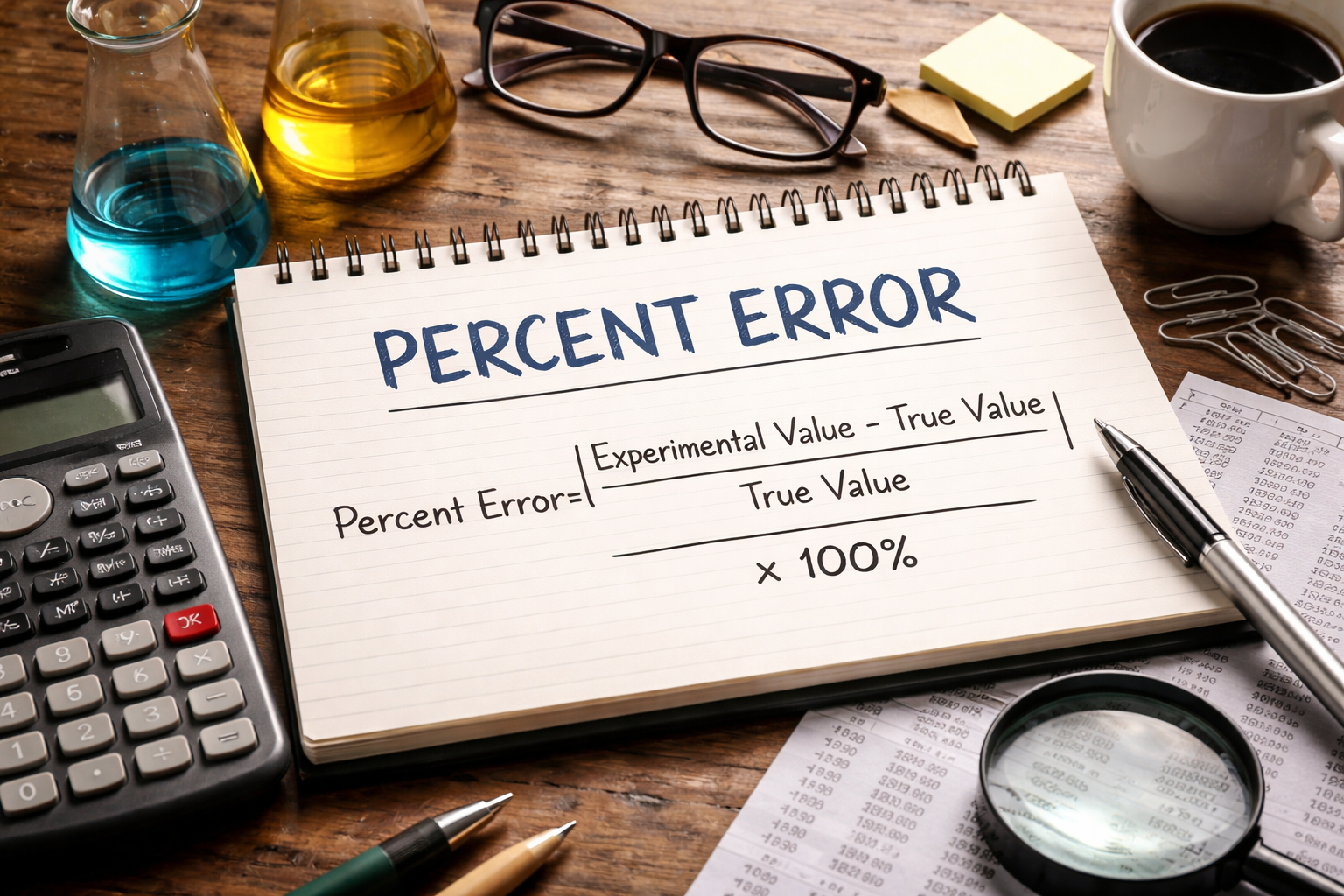
The calculation of percent error follows a standard formula used in mathematics and science:
Percent Error = |Experimental Value − Accepted Value| ÷ Accepted Value × 100
The vertical lines around the subtraction represent the absolute value. This means the result should always be positive, even if the experimental value is smaller than the accepted value.
Using this formula converts the difference between values into a percentage, which makes it easier to interpret and compare.
Why Percent Error Is Important
Understanding percent error is essential in many fields because it helps evaluate the quality of measurements and calculations. It allows scientists, engineers, and students to identify mistakes and improve their methods.
In laboratory experiments, measurements are rarely perfect. Instruments may have small limitations, and human observation may introduce slight inaccuracies. By calculating percent error, researchers can determine whether their results fall within an acceptable range.
This concept is also useful in education. Teachers often ask students to calculate percent error after completing experiments. Doing so encourages critical thinking and helps students learn how to analyze their own work.
Another reason percent error is important is that it allows easy comparison between results. When differences are expressed as percentages, it becomes simpler to understand the scale of the error.
How to Calculate Percent Error Step by Step
Calculating percent error may seem complicated at first, but it becomes straightforward once the process is understood. The following steps explain how to perform the calculation correctly.
First, determine the experimental value. This is the value obtained from the experiment or measurement.
Second, identify the accepted value. This value usually comes from reliable sources such as textbooks, scientific databases, or standard measurements.
Third, subtract the accepted value from the experimental value. Because the formula requires the absolute value, the result should always be positive.
Fourth, divide the difference by the accepted value.
Finally, multiply the result by 100 to convert the decimal into a percentage.
Following these steps ensures that the percent error calculation is accurate and easy to understand.
Example of Percent Error Calculation
Imagine a student performs an experiment to measure the boiling point of water. The student records a temperature of 102°C. However, the accepted boiling point of water at standard pressure is 100°C.
102 − 100 = 2
Next, divide the difference by the accepted value:
2 ÷ 100 = 0.02
Finally, multiply by 100:
0.02 × 100 = 2%
In this case, the percent error is 2%. This means the student’s measurement is very close to the accepted value.
Common Causes of Percent Error
Percent error often occurs because measurements are not perfectly precise. Many factors can contribute to differences between experimental and accepted values.
One common cause is instrument limitations. Measuring tools such as rulers, thermometers, or scales may not be perfectly accurate. Even small calibration issues can lead to slight variations in results.
Human observation is another factor. When people read measurements from instruments, small mistakes can happen. For example, misreading a scale or recording numbers incorrectly can increase percent error.
Environmental conditions can also affect results. Temperature, humidity, pressure, or external interference may change how experiments behave.
Procedural mistakes are another possible reason. If an experiment is not conducted carefully or consistently, the final measurement may deviate from the accepted value.
Recognizing these factors helps researchers reduce errors and produce more reliable results.
Percent Error vs Absolute Error
Students often confuse percent error with absolute error because both involve differences between values.
Absolute error simply measures the numerical difference between the experimental value and the accepted value. It does not convert the result into a percentage.
Percent error, on the other hand, expresses the difference relative to the accepted value. This makes it easier to compare errors across different experiments or measurements.
For example, an absolute error of 2 units might be small in some situations but large in others. When converted into a percentage, the impact becomes clearer.
Because of this, percent error is often more useful when analyzing data in scientific studies.
Tips for Reducing Percent Error
Although some level of error is unavoidable, several strategies can help reduce percent error in experiments and calculations.
One important step is using high-quality instruments. Accurate tools improve measurement precision and reduce the likelihood of large differences.
Another useful approach is repeating experiments multiple times. When several measurements are taken and averaged, the final result often becomes closer to the accepted value.
Careful observation is also essential. Taking time to read instruments correctly and record data accurately helps prevent mistakes.
Proper experimental procedures also play a significant role. Following clear and consistent methods ensures that results remain reliable.
Finally, calibration of instruments should not be ignored. Regularly checking and adjusting tools ensures they provide correct readings.
Applying these techniques can greatly improve accuracy and lower percent error in many situations.
Real-World Applications of Percent Error
The concept of percent error extends far beyond classroom exercises. It plays an important role in many real-world fields.
In engineering, professionals rely on precise measurements to design structures, machines, and systems. Calculating percent error helps ensure that designs meet safety and performance standards.
Medical research also depends on accurate data. Scientists often compare experimental results with known values to evaluate the reliability of medical tests or treatments.
Manufacturing industries use percent error to monitor product quality. If measurements deviate too much from specifications, adjustments are made to maintain consistency.
Even in everyday life, this concept can be helpful. For example, when comparing estimated costs to actual expenses, the idea behind percent error helps evaluate accuracy.
These examples show how widely this measurement is used in both scientific and practical contexts.
Conclusion
Understanding percent error is an essential skill for anyone working with measurements, experiments, or data analysis. It provides a clear and simple way to evaluate how close a result is to the accepted value. By expressing differences as percentages, this concept makes it easier to interpret accuracy and compare results across different situations.
The calculation itself is straightforward, yet the insight it provides is extremely valuable. From classroom laboratories to professional research environments, percent error helps identify mistakes, improve methods, and ensure reliable outcomes.
Although errors cannot be eliminated completely, they can be reduced through careful measurement, proper procedures, and repeated testing. Learning how to calculate and interpret percent error allows students and professionals alike to better understand their results and strengthen the reliability of their work.
