

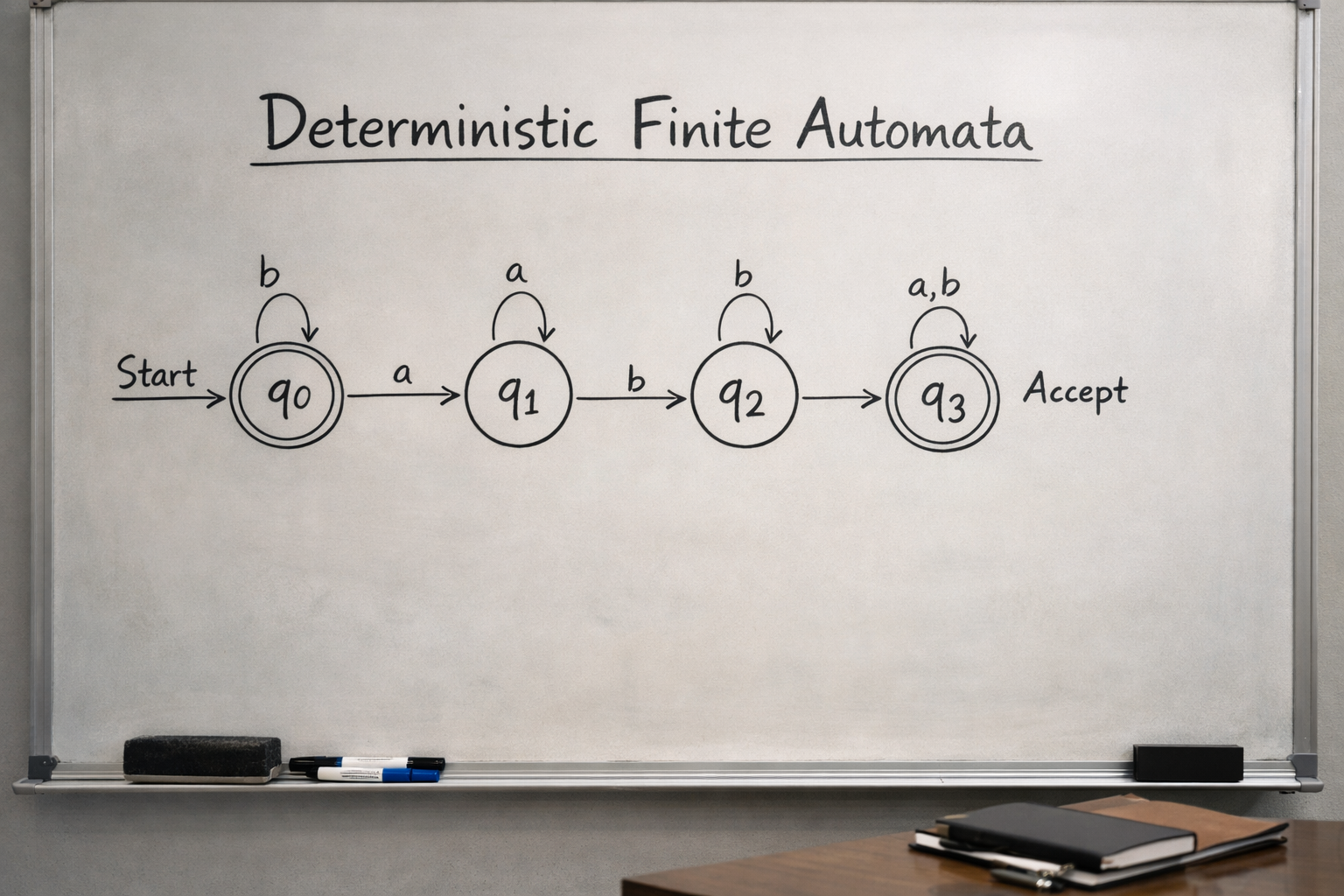
In the world of computer science, the concept of computation often begins with simple yet powerful models. One such foundational model is the deterministic finite automata. It plays a vital role in understanding how machines process input and make decisions. From compilers to text processing tools, this concept is widely used in real-life applications.
A deterministic finite automata, often shortened as DFA, is a mathematical model used to recognize patterns within input data. It reads a sequence of symbols and decides whether the sequence belongs to a specific language or not. This makes it an essential topic for students and professionals working in fields like software engineering, artificial intelligence, and data processing.
This article provides a clear and structured explanation of deterministic finite automata. It explores its definition, components, working principles, advantages, and practical applications.
What Is Deterministic Finite Automata?
A deterministic finite automata is a theoretical machine used in the study of computation. It consists of a finite number of states and transitions between those states based on input symbols. The term “deterministic” means that for every input, the machine has exactly one possible action.
In simpler words, when the automaton reads a symbol, it knows exactly which state to move to next. This makes the behavior of a deterministic finite automata predictable and easy to analyze.
It is commonly used to recognize regular languages, which are sets of strings defined by specific rules.
Key Components of Deterministic Finite Automata
To understand how a deterministic finite automata works, it is important to know its main components.
States
States are the different conditions or positions the automaton can be in. A DFA has a finite number of states, including one start state and one or more accepting states.
Alphabet
The alphabet is a set of symbols that the automaton can read. These symbols form the input strings processed by the DFA.
Transition Function
In a deterministic finite automata, each state has exactly one transition for each symbol in the alphabet.
Start State
This is the state where the automaton begins processing the input string.
Accepting States
These are the states that indicate successful recognition of a string. If the automaton ends in one of these states after reading the input, the string is accepted.
How Deterministic Finite Automata Works
The working of a deterministic finite automata follows a simple process. It starts at the initial state and reads the input string one symbol at a time. For each symbol, it follows a transition defined by the transition function.
As the automaton reads each symbol, it changes its state accordingly. After processing the entire input string, it checks whether it is in an accepting state. If it is, the input is accepted. Otherwise, it is rejected.
For example, consider a DFA designed to recognize strings that end with the letter “a.” As it reads each character, it moves through states that track whether the last character is “a.” If the final state reflects this condition, the string is accepted.
Characteristics of Deterministic Finite Automata
A deterministic finite automata has several unique features that make it useful in computation.
It always has exactly one transition for each input symbol in a given state. This ensures that the system behaves in a predictable manner. There is no randomness or ambiguity in its operation.
It does not require memory beyond its current state. This makes it efficient but also limits its ability to recognize more complex patterns.
It processes input in a linear manner, meaning it reads the string from left to right without going back.
Advantages of Deterministic Finite Automata
The deterministic finite automata offers several advantages, especially in practical applications.
Since it has a clear and fixed behavior, it is easy to design and implement. This makes it suitable for beginners learning about computational models.
Another advantage is efficiency. Because there is only one possible transition for each input, the processing time is fast and predictable.
It is also widely used in software tools such as lexical analyzers, where quick and accurate pattern matching is required.
Limitations of Deterministic Finite Automata
Despite its usefulness, the deterministic finite automata has some limitations.
It cannot handle problems that require memory of past inputs beyond its current state. This means it cannot recognize certain complex languages.
Additionally, designing a DFA for very large or complicated patterns can result in a large number of states. This may make the system harder to manage.
Applications of Deterministic Finite Automata
The deterministic finite automata is not just a theoretical concept. It has many practical applications in computing.
Text Processing
DFA is widely used in text editors and search tools. It helps in finding patterns within large amounts of text quickly and efficiently.
Compiler Design
In compilers, DFA is used in lexical analysis. It helps in breaking down source code into tokens, which are easier for the compiler to understand.
Network Security
It is also used in intrusion detection systems. These systems analyze data packets and detect patterns that may indicate security threats.
Digital Circuits
DFA concepts are applied in the design of digital systems and circuits, where predictable behavior is essential.
Difference Between DFA and Other Automata
It is useful to compare deterministic finite automata with other models to understand its role better.
A nondeterministic finite automata (NFA) allows multiple possible transitions for a given input. This makes it more flexible but harder to implement directly.
In contrast, a deterministic finite automata has only one path for each input, making it easier to execute in real systems.
Both models are equally powerful in terms of the languages they can recognize, but DFA is preferred in practical applications due to its simplicity.
Designing a Deterministic Finite Automata
Creating a deterministic finite automata involves defining its components clearly. First, identify the problem and the type of strings you want to recognize.
Next, determine the set of states required to represent different conditions. Then define the alphabet and create a transition function that connects the states.
Finally, choose the start state and mark the accepting states. Testing the DFA with different input strings helps ensure its correctness.
Conclusion
The deterministic finite automata is a fundamental concept in computer science that provides a simple yet powerful way to model computation. Its structured approach to processing input makes it highly useful in various applications, from text processing to compiler design.
Although it has certain limitations, its advantages in terms of simplicity, speed, and predictability make it a preferred choice in many real-world systems. Understanding deterministic finite automata not only builds a strong foundation in theoretical computer science but also helps in solving practical problems efficiently.
By mastering this concept, learners can gain deeper insight into how machines interpret and process information, paving the way for more advanced studies in computing.
