

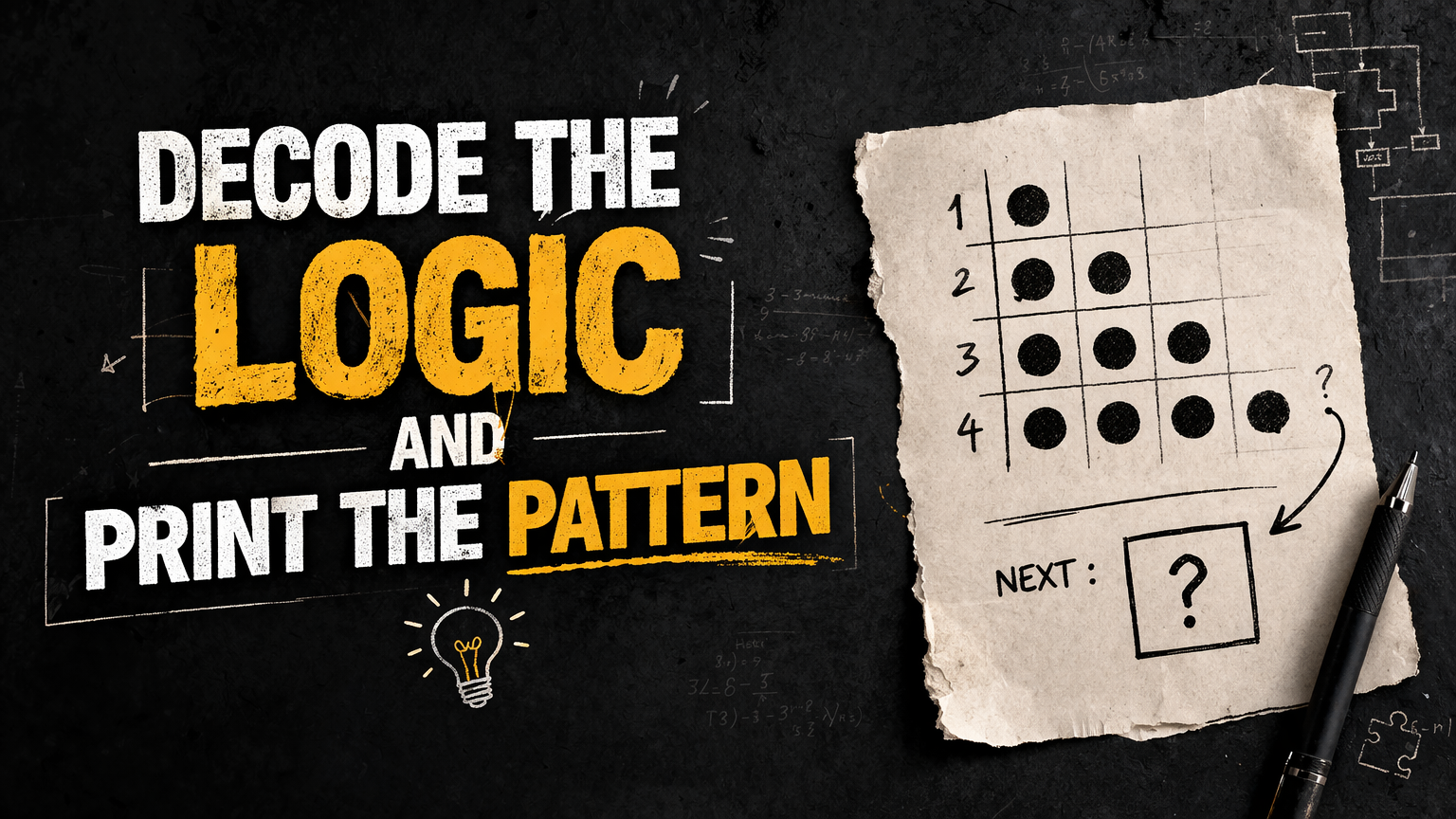
Understanding how to decode the logic and print the pattern is an essential skill in programming. It strengthens problem-solving ability and improves logical thinking. Many learners face difficulty when they first encounter pattern-based questions because these problems require more than basic syntax knowledge. They demand clarity, observation, and structured thinking.
In this article, you will learn how to approach pattern problems step by step. The focus will remain on simple explanations, practical examples, and clear strategies. By the end, you will feel more confident in solving such questions with ease.
What Does It Mean to Decode the Logic and Print the Pattern?
When programmers talk about pattern printing, they refer to displaying characters, numbers, or symbols in a structured format. These patterns can be in the form of triangles, pyramids, diamonds, or even complex shapes.
To decode the logic and print the pattern, you must first understand how the pattern is formed. Every pattern follows a rule. Your task is to identify that rule and translate it into code.
For example, consider a simple pattern:
*
**
***
****
At first glance, it looks simple. However, it is built on a clear rule: each row adds one more star than the previous row. Recognizing this rule is the key step.
Why Pattern Problems Are Important
Pattern-based questions are not just academic exercises. They play a vital role in developing logical thinking. When you decode the logic and print the pattern, you train your mind to break complex problems into smaller steps.
These problems also help you understand loops better. Concepts like nested loops become clearer when you practice patterns. Moreover, they prepare you for coding interviews, where such questions are commonly asked.
Basic Concepts You Need to Know
Before you start solving pattern problems, you should have a basic understanding of a few programming concepts.
Loops
Loops are the foundation of pattern printing. Most patterns use nested loops, where one loop controls rows and another controls columns.
Conditional Statements
Conditions help control what gets printed. For example, you may print a star only when a certain condition is true.
Counters and Variables
Variables help track the number of spaces, stars, or numbers needed in each row.
Step-by-Step Approach to Decode the Logic and Print the Pattern
Solving pattern problems becomes easier when you follow a structured method.
Step 1: Observe the Pattern Carefully
Look at the pattern and identify changes between rows. Ask yourself questions like:
- How many rows are there?
- What changes in each row?
- Are there spaces involved?
Observation is the most important step.
Step 2: Break the Pattern into Rows and Columns
Think of the pattern as a grid. Each row contains columns. This view helps you map the problem into loops.
For example, if a pattern has 5 rows, your outer loop will run 5 times.
Step 3: Identify the Relationship
Check how elements change from one row to another. It could be increasing numbers, decreasing spaces, or alternating characters.
Step 4: Write the Logic in Simple Steps
Before coding, write the logic in plain language. For example:
- Start with 1 star
- Increase stars by 1 in each row
- Print a new line after each row
Step 5: Convert Logic into Code
Once the logic is clear, coding becomes straightforward. Use loops and conditions to implement the pattern.
Common Types of Patterns
To better understand how to decode the logic and print the pattern, it is useful to explore common categories.
Star Patterns
These are the most basic patterns. They use symbols like * to form shapes.
Example:
*****
****
***
**
*
The logic here is decreasing stars in each row.
Number Patterns
These patterns involve numbers instead of symbols.
Example:
1
12
123
1234
The rule is simple: numbers increase in each row.
Pyramid Patterns
Pyramid patterns involve spaces and symbols.
Example:
*
***
*****
*******
Here, spaces decrease while stars increase.
Inverted Patterns
These patterns are the reverse of standard patterns. They require careful observation of how elements decrease.
Tips to Master Pattern Printing
Learning how to decode the logic and print the pattern becomes easier with practice. Here are some useful tips.
Start with Simple Patterns
Begin with basic patterns before moving to complex ones. This builds confidence and strengthens understanding.
Practice Daily
Consistency is key. Even solving one pattern daily can improve your skills significantly.
Focus on Logic, Not Memorization
Avoid memorizing solutions. Instead, try to understand the logic behind each pattern.
Use Pen and Paper
Drawing patterns manually helps you visualize the structure. This makes it easier to translate into code.
Debug Step by Step
If your code does not work, check each loop and condition carefully.
Common Mistakes to Avoid
Many learners struggle with pattern problems due to common errors.
One common mistake is not observing the pattern properly. Without understanding the structure, coding becomes confusing.
Another mistake is incorrect loop limits. If loops run too many or too few times, the pattern will not match.
Also, ignoring spaces can break the pattern. Spaces are as important as symbols in many designs.
Practical Example Explained
Let us consider a simple example:
1
22
333
4444
Understanding the Logic
- The number represents the row number.
- Each row repeats the same number.
- The number of repetitions equals the row number.
Writing the Logic
- Loop from 1 to 4 (rows)
- For each row, print the row number multiple times
Key Insight
This example shows that patterns are often based on relationships between rows and values. Once you identify this relationship, solving becomes easy.
Advanced Thinking for Complex Patterns
As you progress, patterns become more complex. They may include diagonals, symmetry, or mixed elements.
To handle such patterns:
- Divide the pattern into sections
- Solve each section separately
- Combine the logic
This method reduces complexity and improves clarity.
How Pattern Problems Improve Programming Skills
When you regularly decode the logic and print the pattern, you develop strong analytical skills. You learn how to approach problems systematically.
These problems also improve your understanding of loops and conditions. They teach you how to think like a programmer.
Moreover, they prepare you for real-world coding challenges, where logic plays a key role.
Conclusion
Learning how to decode the logic and print the pattern is a valuable step in your programming journey. It may seem difficult at first, but with practice and the right approach, it becomes easier.
Focus on understanding the structure of patterns rather than memorizing solutions. Break problems into smaller steps and work through them patiently. Over time, your confidence will grow, and you will be able to solve even complex patterns with ease.
Pattern problems are not just exercises; they are tools to sharpen your mind. With consistent effort, you will master the art of logical thinking and improve your overall programming skills.
