

Modern networks connect billions of devices, allowing computers, smartphones, servers, printers, sensors, and other systems to exchange information within seconds. Behind this communication is a fundamental networking concept: the node. Whether you are browsing a website, sending an email, streaming a video, or accessing files from a shared server, nodes play an important role in making that communication possible.
Understanding nodes is useful for students, IT professionals, network administrators, and anyone who wants to learn how computer networks work. A node can represent different types of connected devices, and its role depends on the network and the services it provides. This guide explains what a node is, how it works, the different types of nodes, and why nodes are important in modern networking.
What Is a Node in Networking?
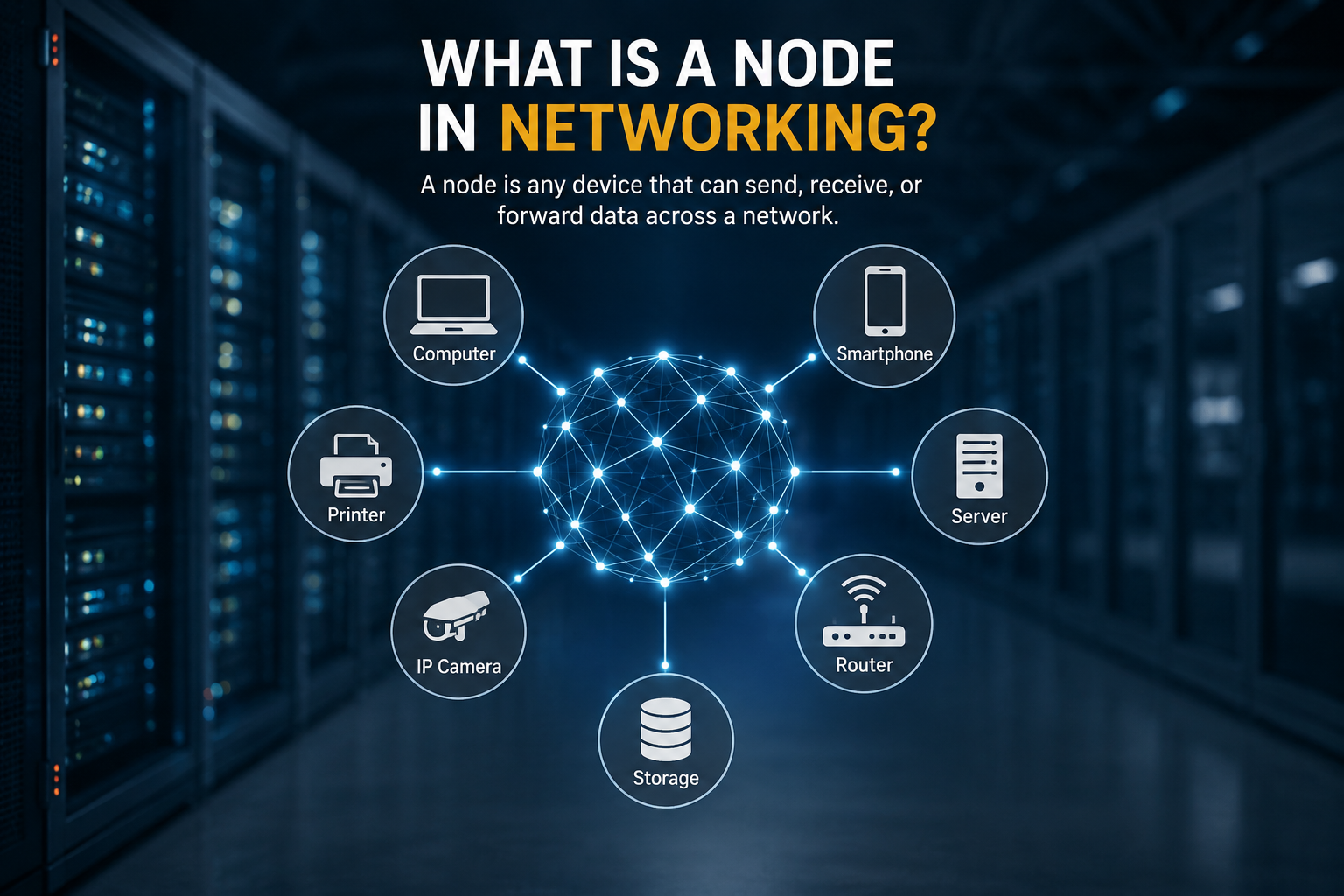
A node in networking is any device or connection point that can send, receive, process, or forward data across a network. In simple terms, a node is a device that participates in network communication.
Computers, smartphones, network printers, routers, switches, servers, and some Internet of Things (IoT) devices can all function as nodes. A node normally has a network address or another method of identification that allows other devices to communicate with it.
For example, when a laptop connects to a home Wi-Fi network, the laptop becomes a network node. The wireless router is another node, while a smartphone connected to the same network represents another. These devices communicate through networking protocols that determine how data is transmitted and received.
The term is broad because not every node performs the same job. Some nodes primarily generate or consume information, while others help direct traffic between different parts of a network.
How Does a Network Node Work?
A node participates in communication by transmitting, receiving, processing, or forwarding data. The exact process depends on the device’s function.
When one device wants to communicate with another, information is usually divided into packets. Networking equipment and protocols determine where those packets should go and how they should reach their destination.
For example, suppose a computer requests a webpage from a remote server. The computer sends a request through its local network. A router can forward the traffic toward the Internet, where additional networking devices help move the packets toward the destination server. The server then processes the request and sends information back.
Each participating device may perform a different function, but together these nodes form the infrastructure that supports communication.
Network Addresses and Identification
Nodes need a way to be identified so that data can reach the correct destination. In Internet Protocol networks, devices can use IP addresses for logical identification. Hardware interfaces may also have MAC addresses used for communication at the data-link layer.
An IP address can change depending on the network and configuration, while a MAC address is generally associated with a network interface. The combination of addressing and networking protocols helps devices determine where information should be delivered.
Common Types of Network Nodes
Different devices can operate as nodes, depending on their purpose and network architecture.
Computers and Laptops
Desktop computers and laptops are common end nodes. They generate and receive data when users browse websites, transfer files, use applications, or communicate online.
These devices usually depend on other network infrastructure, such as switches, wireless access points, routers, and servers, to reach other destinations.
Smartphones and Tablets
Mobile devices become nodes whenever they connect to a Wi-Fi or cellular network. They can exchange information with local devices, cloud services, websites, and other systems.
Because smartphones frequently move between networks, their network configuration can change as they connect to different access points or cellular networks.
Servers
Servers are specialized nodes that provide resources or services to other devices. A web server may deliver webpages, while a file server can provide shared documents and storage.
A single server can communicate with many clients simultaneously, depending on its hardware, software, network capacity, and workload.
Routers
Routers are important networking nodes because they connect different networks and forward packets between them. A router examines information in network packets and uses routing information to determine where traffic should go next.
A typical home router connects devices on a local network to an Internet service provider. In larger networks, routers can connect offices, data centers, regions, or separate organizational networks.
Switches
A network switch connects devices within a local network and forwards Ethernet frames toward the appropriate destination. Modern switches commonly use MAC addresses to make forwarding decisions.
Switches are widely used in offices, schools, data centers, and other environments where multiple wired devices need to communicate.
Network Printers
Network-enabled printers can also function as nodes. They receive print jobs from computers and other devices through a network connection.
This eliminates the need for every computer to have a direct physical connection to the printer.
IoT Devices
Internet of Things devices are another important category of network nodes. Smart cameras, sensors, thermostats, appliances, industrial monitoring systems, and wearable devices can communicate through networks.
Many IoT environments contain large numbers of nodes, making device management and security particularly important.
End Nodes and Intermediate Nodes
Network nodes are often discussed according to their role in communication.
End nodes, sometimes called endpoint devices, are typically the source or destination of data. Examples include computers, smartphones, servers, and network-connected printers.
Intermediate nodes help move traffic between endpoints. Routers and switches are common examples, although their specific functions differ.
Consider a simple office network. A workstation may generate a request, a switch may forward the traffic inside the local network, and a router may send the traffic toward another network. Each device contributes to successful communication.
This distinction helps network professionals understand how traffic moves through an infrastructure.
Why Are Nodes Important?
Nodes are fundamental because networks exist to allow connected devices and systems to communicate. Without participating devices and networking infrastructure, data could not move between different destinations.
Nodes also make networks scalable. Organizations can add computers, servers, printers, sensors, and other equipment as their needs grow. Networking technologies provide mechanisms for these devices to communicate while maintaining organization and control.
In cloud computing and distributed systems, the concept becomes even more significant. Applications may run across numerous machines, with different nodes handling different workloads.
Nodes in Different Types of Networks
The meaning of a node remains similar across different network environments, but its role can vary.
Local Area Networks
In a LAN, nodes may include computers, printers, servers, switches, access points, and other connected equipment. These devices typically operate within a limited geographic area such as a home, office, school, or building.
Wide Area Networks
WANs connect networks across larger geographic distances. Routers and other networking equipment act as important nodes for moving traffic between locations.
The Internet itself can be viewed as an enormous interconnected system containing countless nodes operated by individuals, businesses, organizations, and service providers.
Wireless Networks
Wireless networks use radio communication to connect devices. Smartphones, laptops, tablets, wireless printers, and access points can participate as nodes.
Wireless nodes must share radio resources, making factors such as interference, signal strength, and network congestion important.
Peer-to-Peer Networks
In a peer-to-peer network, devices can communicate directly and may provide resources to one another. A node can sometimes act as both a client and a provider of resources.
This differs from a traditional client-server model, where clients typically request services from dedicated servers.
Node vs. Host: Are They the Same?
The terms node and host are related but are not always interchangeable.
A host generally refers to a device connected to a network that has a network address and can communicate using network protocols. A node is a broader term that can include hosts as well as networking devices that facilitate communication.
For example, a computer can be considered both a host and a node. A router is commonly described as a node, but depending on the context, it may not be called a host.
The exact terminology can vary between networking textbooks, technologies, and professional environments.
How Nodes Communicate With Each Other
Nodes rely on networking protocols to communicate. Protocols establish rules for formatting, transmitting, routing, and receiving data.
Common networking technologies and protocols operate at different layers. Ethernet and Wi-Fi handle important aspects of local connectivity, while IP provides addressing and routing. Higher-level protocols support specific services such as web browsing, email, file transfers, and name resolution.
When a user enters a website address into a browser, several networking processes can occur before the requested content appears. The user’s device communicates with network infrastructure, resolves the destination, sends packets toward the appropriate server, and receives a response.
The process may involve many nodes, even though the user sees only the final webpage.
Node Security and Network Management
Every connected node can potentially introduce security and management challenges. Unsecured devices may become entry points for attackers, while poorly configured equipment can cause connectivity problems.
Organizations commonly use practices such as strong authentication, access controls, software updates, network segmentation, monitoring, and endpoint security to protect nodes.
Network administrators also monitor devices to identify performance issues. High traffic, packet loss, hardware failures, or configuration errors can affect communication between nodes.
As organizations add more IoT devices and cloud-connected systems, maintaining an accurate inventory of network nodes becomes increasingly important.
Examples of Nodes in Everyday Life
A home network provides a simple example. Imagine a household with a wireless router, two laptops, three smartphones, a smart television, and a network printer.
Each connected device can participate as a node. The router provides connectivity between the local network and external networks, while the laptops and smartphones generate and consume data. The television may stream content, and the printer receives jobs from other devices.
In a business environment, the number of nodes can be much larger. Employees may use computers and phones while servers, switches, routers, security appliances, access points, storage systems, and IoT devices operate in the background.
Final Thoughts
A network node is a fundamental building block of computer networking. It refers broadly to a connected device or communication point that can participate in sending, receiving, processing, or forwarding data. Computers, smartphones, servers, routers, switches, printers, and IoT devices can all serve as nodes in different circumstances.
Understanding nodes provides a foundation for learning more advanced networking concepts, including IP addressing, routing, switching, network security, and distributed computing. Although nodes can perform very different jobs, they work together through standardized technologies and protocols to keep information moving reliably.
As networks continue to expand across homes, businesses, cloud platforms, data centers, and connected devices, understanding how nodes communicate remains an essential part of understanding the digital world.
