

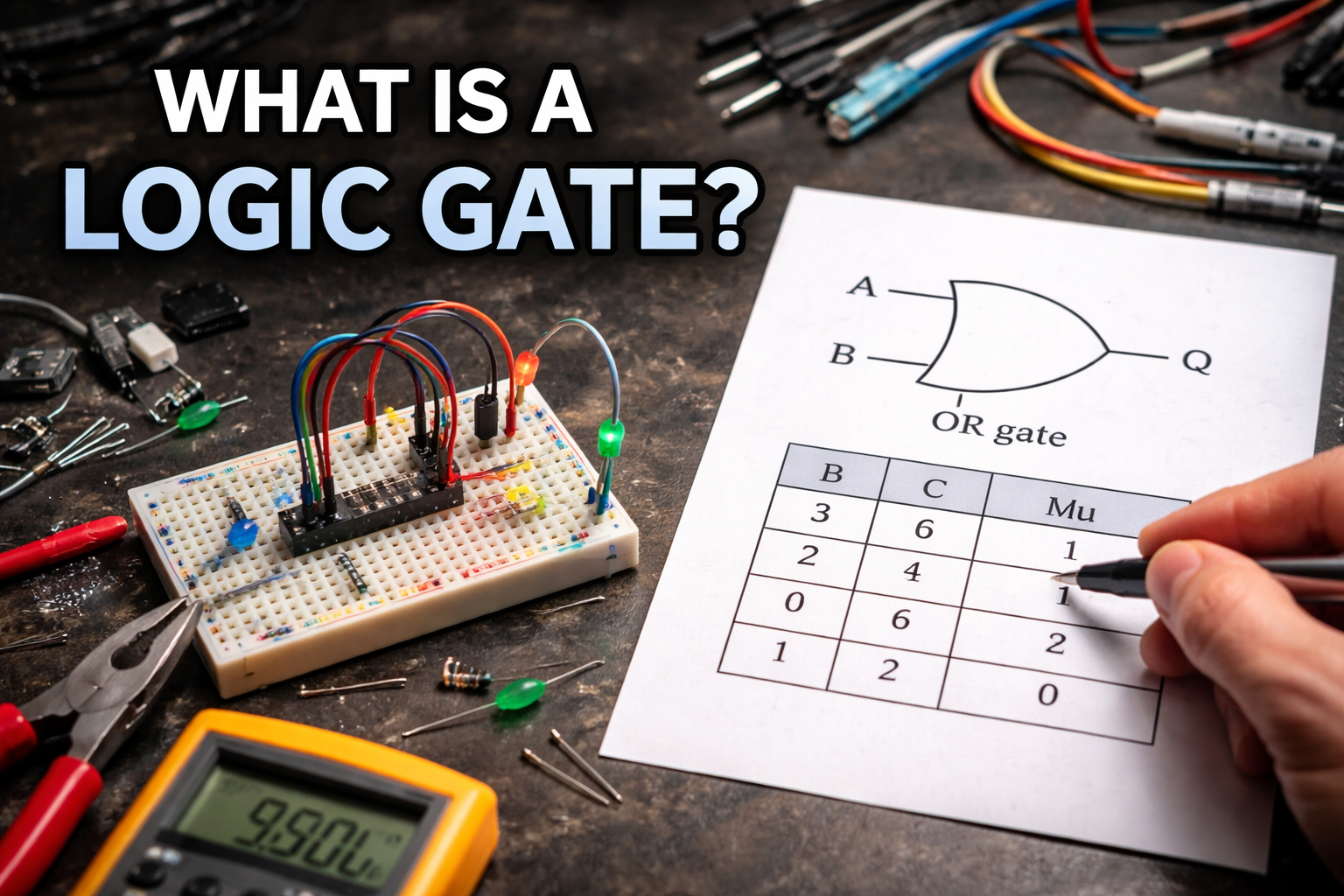
In today’s digital world, almost every device you use—whether a smartphone, computer, or smart appliance—relies on tiny electronic components working together to process information. At the core of these systems lies a fundamental concept known as the logic gate. Understanding what a logic gate is can help you grasp how digital systems make decisions, perform calculations, and execute tasks with speed and accuracy.
This article explains what a logic gate is, how it works, and why it is essential in modern technology. It presents the topic in a simple and clear way, making it suitable for beginners as well as those looking to refresh their knowledge.
What Is a Logic Gate?
A logic gate is a basic electronic circuit that performs a logical operation on one or more input signals to produce a single output. These inputs and outputs are usually represented in binary form, meaning they take values of either 0 (low/off) or 1 (high/on).
In simple terms, a logic gate acts like a decision-maker. It receives signals, processes them based on a defined rule, and then produces a result. These rules follow the principles of Boolean algebra, which is a system of mathematics used to analyze logical expressions.
Every complex system, from simple calculators to advanced computers, is built using combinations of these small but powerful circuits.
How Logic Gates Work
Logic gates operate using electrical signals. Depending on the type of gate, the output changes according to the input values.
For example, if a gate receives two inputs, it evaluates them based on its logic rule. If the condition is satisfied, it outputs a 1. If not, it outputs a 0. This simple process allows digital systems to perform operations such as addition, comparison, and data storage.
The behavior of a logic gate is often described using a truth table. A truth table shows all possible input combinations and their corresponding outputs, making it easier to understand how a gate functions.
Types of Logic Gates
There are several types of logic gates, each designed to perform a specific logical function. The most common ones are described below.
AND Gate
If any input is 0, the output becomes 0. This gate is used when multiple conditions must be true at the same time.
OR Gate
It produces 0 only when all inputs are 0. This gate is useful when any one condition being true is sufficient.
NOT Gate
The NOT gate, also known as an inverter, has a single input and reverses its value. If the input is 1, the output becomes 0, and vice versa. It is used to change the state of a signal.
NAND Gate
The NAND gate is the opposite of the AND gate. It outputs 0 only when all inputs are 1. In all other cases, it outputs 1. This gate is widely used because it can be used to create other logic gates.
NOR Gate
The NOR gate is the opposite of the OR gate. It produces 1 only when all inputs are 0. Otherwise, the output is 0. Like the NAND gate, it is also considered a universal gate.
XOR Gate
The XOR (exclusive OR) gate outputs 1 when the inputs are different. If the inputs are the same, the output is 0. It is commonly used in circuits that require comparison.
XNOR Gate
The XNOR gate is the opposite of the XOR gate. It outputs 1 when the inputs are the same and 0 when they are different. It is often used in equality checking operations.
Importance of Logic Gates in Digital Systems
Logic gates are essential because they form the building blocks of all digital circuits. They enable systems to process information in a structured and reliable way.
Every operation inside a computer, from basic arithmetic to complex algorithms, depends on logic gates. They are used in processors, memory units, and communication devices. Even simple devices like digital clocks and calculators rely on these gates to function.
By combining multiple logic gates, engineers can design circuits that perform advanced tasks. These combinations are known as logic circuits, and they can be as simple as a small control unit or as complex as a microprocessor.
Real-Life Applications of Logic Gates
Logic gates are used in many real-world applications. Their presence is often hidden, but their role is critical in ensuring that devices work correctly.
In computers, logic gates are used to perform calculations and manage data flow. In smartphones, they help process user inputs and control various functions. In industrial systems, they are used for automation and control.
They are also used in security systems, traffic light controllers, and digital communication devices. In each case, logic gates help systems make decisions based on input conditions.
Advantages of Using Logic Gates
Logic gates offer several advantages that make them ideal for digital systems. They are fast, reliable, and capable of handling large amounts of data. Since they operate using binary values, they reduce the chances of errors in processing.
Another advantage is their flexibility. By combining different types of gates, engineers can design circuits for almost any application. This makes logic gates highly versatile and widely used in technology.
They are also compact in size, especially in modern integrated circuits. Millions of logic gates can fit into a single chip, allowing devices to be smaller and more powerful.
Limitations of Logic Gates
Despite their many benefits, logic gates also have some limitations. They require a power supply to operate, which can increase energy consumption in large systems. Heat generation can also be an issue in high-density circuits.
Additionally, designing complex circuits using logic gates can be challenging. It requires careful planning and a deep understanding of digital logic. Errors in design can lead to incorrect outputs or system failures.
However, advances in technology continue to address these challenges, making logic gates more efficient and reliable over time.
Future of Logic Gates
The future of logic gates is closely linked to advancements in technology. As devices become smaller and more powerful, the demand for efficient logic circuits continues to grow.
New materials and designs are being developed to improve performance and reduce energy consumption. Quantum computing and nanotechnology are also opening new possibilities for the evolution of logic gates.
These innovations may lead to faster processing speeds and more advanced digital systems, further expanding the role of logic gates in modern life.
Conclusion
Understanding what is a logic gate is essential for anyone interested in digital electronics and computing. These simple yet powerful circuits form the backbone of all digital systems, enabling devices to process information and perform tasks efficiently.
From basic operations to complex computing processes, logic gates play a crucial role in shaping the technology we use every day. As advancements continue, their importance will only grow, making them a key concept in the future of electronics and innovation.
